SAP vs Salesforce Testing: Understanding the Differences
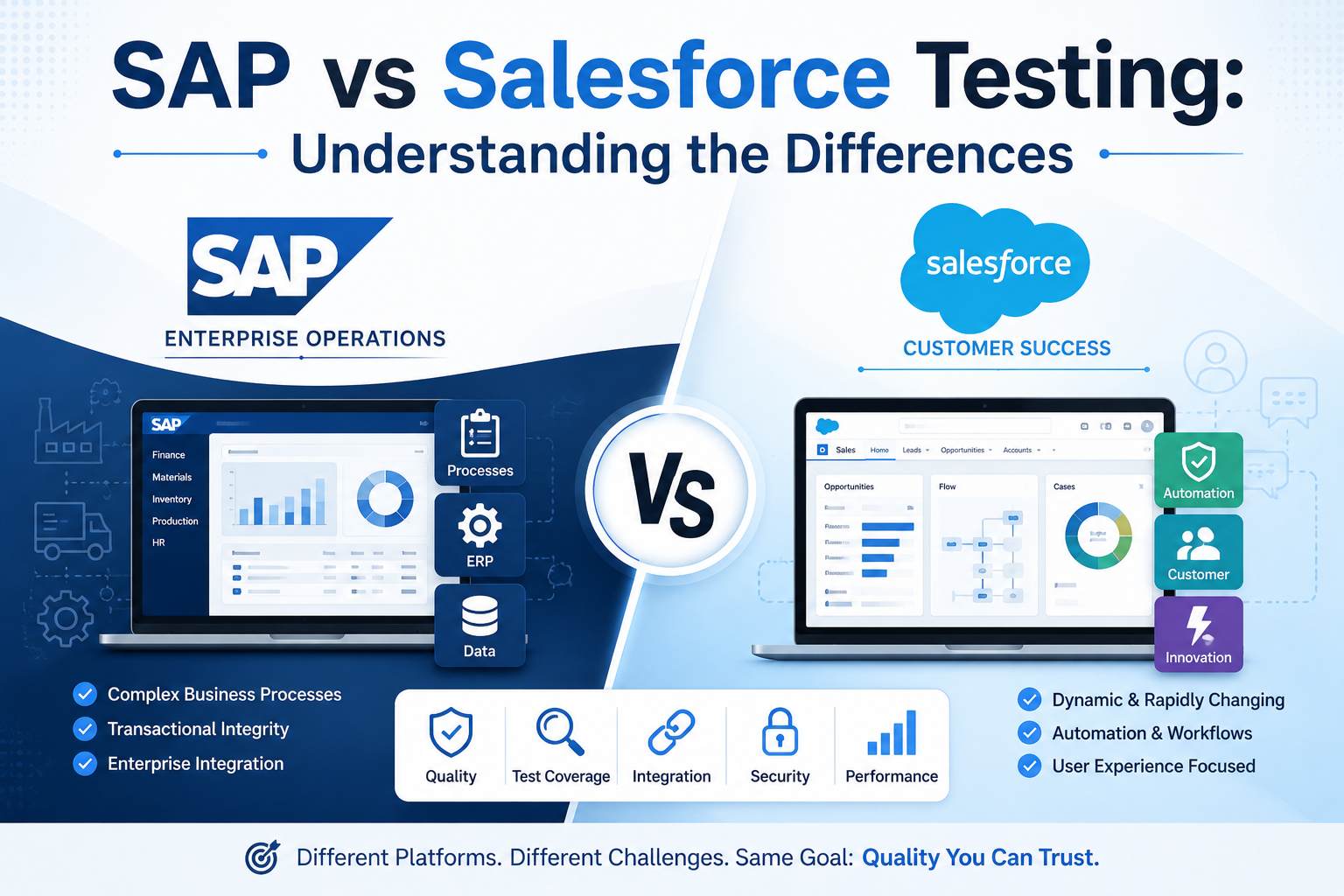
Enterprise organizations often rely on multiple business platforms to support their operations. Two of the most widely recognized enterprise systems are SAP and Salesforce. While both platforms help organizations manage critical business processes, they serve different purposes and present unique testing challenges. As businesses increasingly depend on automation, integrations, and digital workflows, understanding the differences between SAP and Salesforce testing has become more important for quality assurance teams, developers, and business stakeholders.
Organizations frequently compare SAP and Salesforce from a functional perspective, but testing considerations are equally important. Each platform has its own architecture, customization model, integration requirements, and business risks. Testing strategies that work effectively in one environment may not necessarily apply to the other.
For teams using Provar, understanding Salesforce-specific testing requirements is particularly valuable because Salesforce environments often experience rapid change through seasonal releases, Flow automation, integrations, and continuous deployment initiatives.
Understanding the Purpose of SAP and Salesforce
Before comparing testing approaches, it helps to understand the primary role of each platform.
SAP is primarily known as an enterprise resource planning (ERP) system. Organizations use SAP to manage core business functions such as finance, procurement, manufacturing, inventory management, supply chain operations, and human resources.
Salesforce, on the other hand, is primarily a customer relationship management (CRM) platform. It focuses on customer-facing processes such as sales, service, marketing, customer engagement, and business workflow automation.
Although both platforms can be heavily customized and integrated, the business processes they support are often very different.
| Area | SAP | Salesforce |
|---|---|---|
| Primary focus | Enterprise operations and ERP | Customer relationship management |
| Typical users | Finance, operations, supply chain | Sales, service, marketing |
| Business processes | Procurement, inventory, accounting | Leads, opportunities, customer support |
| Customization approach | ERP configuration and extensions | Flows, Apex, Lightning components |
| Release frequency | Generally less frequent | Three major releases annually |
Why Testing Matters in Both Platforms?
Whether an organization uses SAP, Salesforce, or both, testing plays a critical role in maintaining business continuity. Errors within enterprise systems can affect revenue, compliance, customer satisfaction, reporting accuracy, and operational efficiency.
Testing helps verify that:
- business processes function correctly
- integrations exchange data properly
- customizations work as intended
- security controls remain effective
- updates do not introduce regressions
Although these goals are common across both platforms, the specific testing challenges often differ significantly.
How SAP Testing Differs From Salesforce Testing?
SAP testing often focuses heavily on transactional integrity and process continuity across complex operational workflows. A change to procurement logic, inventory management, or financial calculations can affect multiple business units and downstream systems.
Salesforce testing typically focuses on customer-facing workflows, business automation, permissions, integrations, and user experience. Because Salesforce environments frequently evolve through Flows, Apex customizations, and seasonal platform releases, regression testing often becomes a central concern.
In many organizations, Salesforce environments experience faster rates of change than traditional ERP systems, requiring more frequent validation activities.
Customization Creates Different Testing Challenges
Both platforms support extensive customization, but they do so differently.
SAP customizations often involve configuration settings, custom development, business rules, and process-specific enhancements. Testing must confirm that these modifications continue working alongside standard ERP functionality.
Salesforce customizations frequently involve:
- record-triggered Flows
- Apex triggers
- Lightning Web Components
- custom objects
- approval processes
- integration workflows
As customization levels increase, testing complexity also increases because changes can affect multiple connected processes.
Automation Testing in SAP and Salesforce
Automation testing plays an increasingly important role in both platforms. However, organizations often prioritize automation differently depending on system usage.
SAP automation frequently focuses on transactional processes such as:
- purchase orders
- inventory updates
- invoice processing
- financial transactions
Salesforce automation testing commonly focuses on:
- lead management
- opportunity workflows
- customer support processes
- Flow automation
- approval routing
- customer-facing experiences
Because Salesforce environments often change rapidly, automated regression testing becomes particularly valuable for maintaining release confidence.
The Role of End-to-End Testing
Modern enterprise systems rarely operate in isolation. SAP and Salesforce frequently exchange information through APIs, middleware platforms, and enterprise integration frameworks.
For example:
- Salesforce may capture customer orders
- SAP may process fulfillment and billing
- Data may flow through multiple connected systems
This makes End-to-End testing critical for validating complete business processes rather than isolated system functions.
Testing only Salesforce or only SAP may miss issues that appear during cross-platform transactions.
Integration Testing Is Often the Highest-Risk Area
Many enterprise failures occur not within individual platforms but at integration points between systems.
Organizations using SAP and Salesforce together often rely on integrations for:
- customer data synchronization
- order processing
- billing updates
- inventory visibility
- financial reporting
Testing should validate:
- data accuracy
- API responses
- error handling
- retry mechanisms
- security controls
Integration testing becomes increasingly important as organizations expand automation initiatives.
Release Management and Regression Testing
One major difference between SAP and Salesforce testing involves platform update frequency.
Salesforce introduces major seasonal releases three times each year. These updates may affect:
- Flows
- Apex logic
- Lightning Experience
- API behavior
- permissions
As a result, regression testing becomes a continuous requirement for many Salesforce teams.
SAP environments often experience major upgrades less frequently, but upgrades can involve significant business impact due to the operational nature of ERP systems.
In both cases, regression testing helps confirm that existing functionality continues working after changes are introduced.
Security Testing Considerations
Security is important in both platforms, but the testing focus often differs.
SAP security testing commonly emphasizes:
- financial controls
- segregation of duties
- transaction-level permissions
- compliance requirements
Salesforce security testing often focuses on:
- role hierarchies
- sharing rules
- field-level security
- permission sets
- customer data access
Security validation helps ensure users can access the information they need while preventing unauthorized visibility.
Which Platform Is More Challenging to Test?
There is no universal answer because complexity depends heavily on implementation size, customization levels, integrations, and business requirements.
SAP environments may involve highly complex operational processes spanning multiple departments and transaction types.
Salesforce environments may involve rapid release cycles, extensive automation, customer-facing workflows, and frequent configuration changes.
Testing challenges often come from business complexity rather than the platform itself.
Skills Required for SAP and Salesforce Testers
Although some testing principles apply across both systems, each platform requires specialized knowledge.
SAP testers often benefit from understanding:
- ERP concepts
- financial processes
- supply chain operations
- business transactions
Salesforce testers typically need knowledge of:
- CRM processes
- Flow automation
- Apex interactions
- security models
- integration behavior
- release management
Both paths offer strong career opportunities because enterprise organizations increasingly depend on quality assurance to support digital transformation initiatives.
Why Salesforce Testing Continues to Grow?
As organizations adopt more Salesforce automation, testing requirements continue to expand. Modern Salesforce environments often include:
- complex Flows
- multiple integrations
- custom applications
- AI-powered functionality
- continuous deployment pipelines
Because of this complexity, organizations increasingly invest in structured approaches to test Salesforce environments before releasing changes into production.
Automated testing helps improve consistency, reduce manual effort, and support more reliable release cycles.
How Provar Supports Salesforce Testing
Enterprise Salesforce environments require testing that goes beyond basic UI validation. Teams often need to verify business workflows, security models, integrations, and automation behavior across multiple environments.
Provar helps organizations automate Salesforce testing while supporting complex validation requirements. This becomes particularly valuable when testing release updates, business-critical workflows, and automated processes.
Organizations can also incorporate testing into CI/CD Integration pipelines to improve release confidence and accelerate deployment cycles.
Conclusion
SAP and Salesforce are both powerful enterprise platforms, but they serve different business purposes and present different testing challenges. SAP testing often focuses on operational processes, financial transactions, and enterprise resource planning, while Salesforce testing emphasizes customer-facing workflows, automation, integrations, security, and continuous platform evolution.
Neither platform is inherently easier or harder to test. The complexity depends on business requirements, customization levels, integration architecture, and organizational scale. What remains consistent is the importance of structured testing practices that help organizations maintain reliability, security, and business continuity.
For teams working within Salesforce environments, Provar provides a specialized approach to automated testing that helps validate workflows, integrations, permissions, and business processes across increasingly complex enterprise ecosystems.
click here